
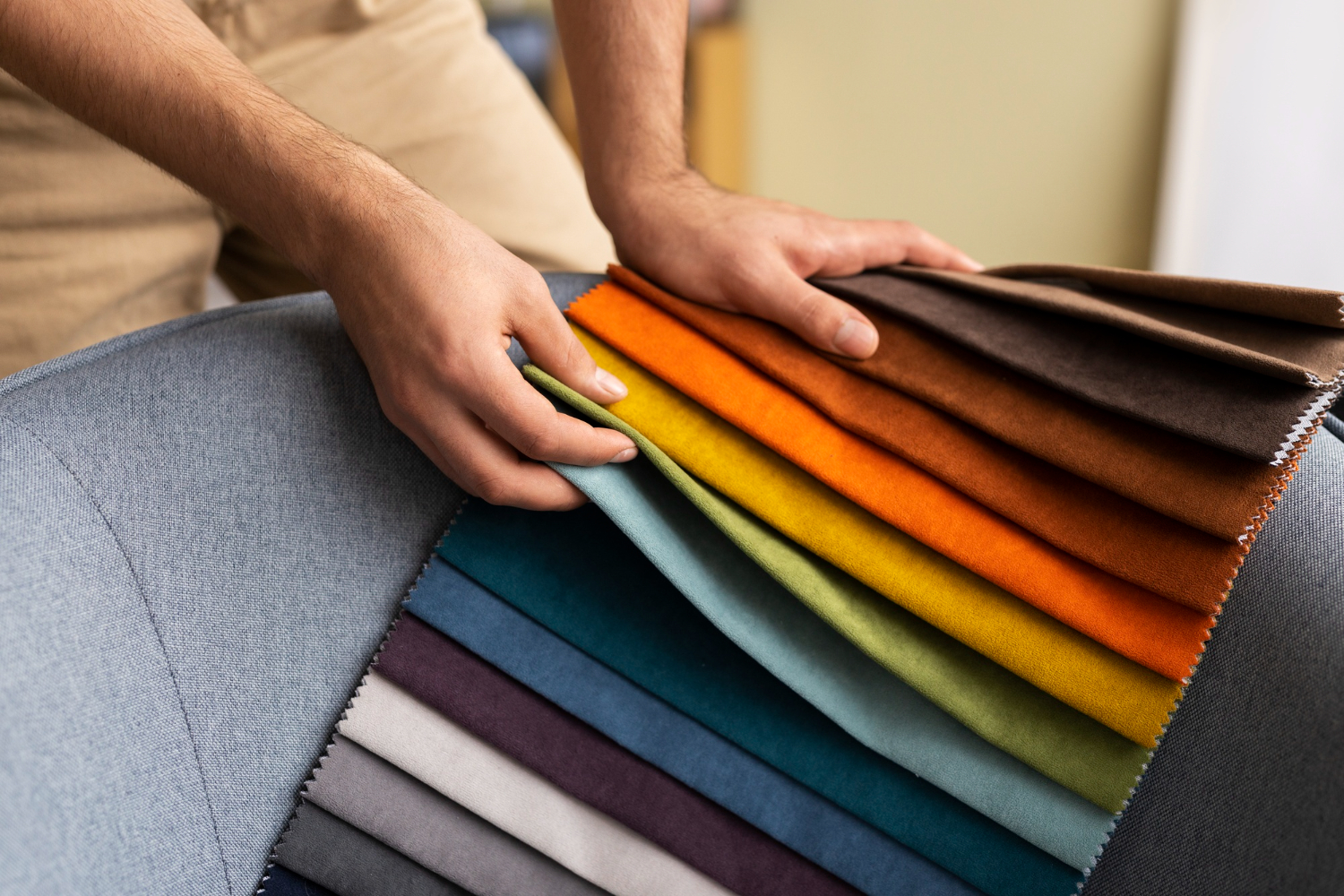
Not all upholstery fabrics are built for real life. Some can handle pets, kids, spills, and daily use for years without much drama. Others look great at first but start breaking down the moment they’re actually lived on.
Durability mostly comes down to three things: fiber type (synthetic vs natural), weave tightness, and resistance to wear and stains. In general, tightly woven synthetics outperform natural fibers in high-traffic homes.
Here’s how common upholstery fabrics stack up when durability is the main concern.
1. Microfiber (Top Tier for Everyday Abuse)
Microfiber is usually considered the most practical upholstery fabric for busy households.
It’s made from ultra-fine polyester fibers woven so tightly that liquid and dirt struggle to penetrate the surface.
Why it ranks #1:
- Extremely stain-resistant (spills bead up instead of soaking in)
- High abrasion resistance for heavy daily use
- Holds shape well over time
- Easy to clean compared to most fabrics
Trade-offs:
- Can attract pet hair
- Not as “luxurious” in texture as natural fibers
Best for: families, pets, high-use sofas, living rooms that actually get lived in.
2. Leather (Long-Term Heavyweight Champion)
Real leather isn’t technically a fabric, but in durability rankings it earns its place.
High-quality leather—especially full-grain—can last decades and often improves visually over time as it develops a patina.
Why it ranks high:
- Extremely strong and abrasion-resistant
- Doesn’t trap dust or allergens
- Spills can be wiped off easily
- Ages instead of breaking down
Trade-offs:
- Expensive
- Can scratch or crack if poorly maintained
- Sensitive to extreme dryness or heat
Best for: long-term investment pieces, low-maintenance cleaning, timeless look.
3. Polyester (Reliable Workhorse Synthetic)
Polyester is one of the most widely used upholstery fabrics because it balances durability and affordability.
Why it ranks high:
- Resistant to fading and stretching
- Holds up well under daily use
- Often blended with other fibers for added strength
Trade-offs:
- Can feel less breathable than natural fibers
- Lower-end versions may pill over time
Best for: budget-friendly sofas and chairs that still need to last.
4. Olefin (Underrated Durability Contender)
Olefin is a synthetic fabric known for toughness in high-wear environments.
Why it performs well:
- Strong resistance to stains and moisture
- Excellent abrasion resistance
- Good color stability in sunlight
Trade-offs:
- Can feel less soft than other fabrics
- Often used in outdoor or commercial furniture
Best for: spill-prone areas, sunlit rooms, indoor/outdoor use.
5. Cotton Blends (Better Than Pure Cotton)
Pure cotton is comfortable but not always durable on its own. Cotton blends improve performance significantly.
Why it works:
- Softer than synthetics
- More breathable than polyester-heavy fabrics
- Improved durability when blended with synthetic fibers
Trade-offs:
- Still absorbs stains more easily than synthetics
- Can wrinkle and wear over time
Best for: casual spaces where comfort matters as much as durability.
6. Wool and Wool Blends (Strong but Niche)
Wool is naturally resilient and has good elasticity, which helps it recover from compression.
Why it holds up:
- Naturally resistant to wear and odor
- Good resilience under pressure
- Often blended to improve durability further
Trade-offs:
- Expensive
- Can pill with heavy friction
- Not ideal for high-stain environments
Best for: colder climates, formal furniture, low-to-moderate traffic spaces.
7. Linen (Stylish but Not Built for Abuse)
Linen looks great, but it’s not designed for heavy everyday use.
Why it ranks lower:
- Wrinkles easily
- Stains quickly
- Better suited for low-traffic furniture
Trade-offs:
- Beautiful texture and natural look
- Can last long in controlled environments
Best for: decorative pieces, adult-only spaces, “don’t eat on this sofa” furniture.
8. Velvet (Varies Widely, Often Delicate)
Velvet’s durability depends heavily on whether it’s natural or synthetic and how it’s constructed.
Reality:
- Can crush or mark easily under pressure
- Shows wear in high-contact areas
- Some synthetic velvets perform better, but still vary widely
Best for: accent furniture, formal seating, low-use rooms.
9. Silk and Decorative Fabrics (Least Durable)
These are almost never used for high-use upholstery for a reason.
Why they rank last:
- Extremely delicate fibers
- Easily stained and damaged
- Require professional cleaning
Best for: decorative or formal furniture only.
Simple Rule to Remember
If you strip everything down:
- Best durability overall: microfiber, leather, polyester blends
- Middle ground: cotton blends, wool blends, olefin
- Looks over longevity: linen, velvet, silk
Durability in upholstery isn’t about what looks expensive—it’s about how the fabric behaves under stress.
If a couch is going to be used daily, synthetic, tightly woven fabrics almost always outperform natural fibers. If it’s more for looks or light use, you can afford to prioritize texture and aesthetics instead.
In furniture, the “best” fabric is really just the one that matches how you actually live.